
Blogs
Sulphur-Free Jaggery
vs Regular Jaggery:
What’s Really in Your Gur
Table of Contents
Toggle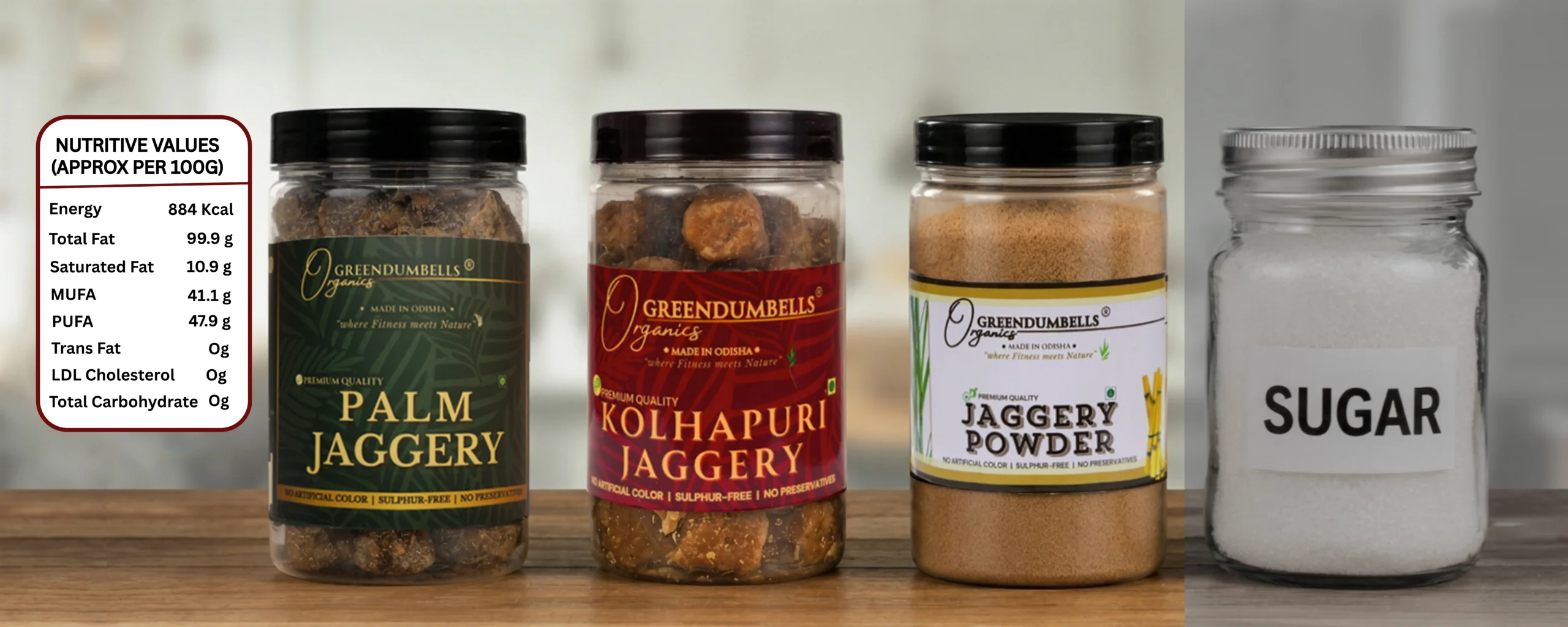
The Traditional Way Jaggery Was Always Made
Jaggery has been produced in India for at least 3,000 years. The traditional process is completely chemical-free: fresh sugarcane juice is extracted, boiled in large open iron pans, stirred continuously as it thickens and reduces, then poured into moulds to solidify. The resulting product is naturally dark brown from the retained molasses, slightly grainy in texture, and intensely aromatic. This process produces what we now call sulphur-free jaggery — though for most of Indian culinary history, it was simply called jaggery.
Traditional Clarification — No Chemicals Needed
The traditional clarifying process uses natural agents — ladyfinger (okra) extract or milk — which naturally attract the impurities in boiling cane juice so they can be skimmed off the top. This produces a clean, golden-amber to dark-brown product without any chemical intervention.
When Sulphur Entered the Picture
As jaggery production was commercialised and scaled for national markets in the 20th century, manufacturers faced a problem: consumers preferred lighter-coloured jaggery, associating it (incorrectly) with higher quality. They also wanted a longer shelf life for transportation and storage.
The solution: sulphur dioxide (SO₂) gas is bubbled through the boiling cane juice during production. SO₂ bleaches the natural molasses colour, producing a lighter, more visually appealing product. It also acts as a preservative, extending shelf life significantly.
What Sulphur Dioxide Does to Jaggery
SO₂ is classified as a food additive (E220) and is regulated by FSSAI in India. Here is what it does: it bleaches away the natural dark colour (which comes from molasses), it extends shelf life by preventing microbial growth, it partially removes the natural mineral-rich molasses fraction (because some molasses is separated along with the impurities during the SO₂ clarification process), and it results in a lighter, smoother, more uniform product that many consumers prefer aesthetically — but at a nutritional cost.
Health Concerns Around SO₂ in Jaggery
Sulphur dioxide triggers asthmatic attacks in sulphite-sensitive individuals — estimated to affect 5-10% of asthmatic patients. Children and the elderly are advised to minimise sulphite intake. Beyond individual health concerns, the fundamental problem is this: people who switch to jaggery to avoid processed sugar are often still consuming an industrial chemical that refined sugar does not contain. Refined sugar is empty calories but is not typically treated with sulphur dioxide.
The Colour Test: What Your Jaggery’s Colour Tells You
This is the most important and actionable insight from this guide. Sulphur-free, traditionally made jaggery is DARKER — typically dark brown, amber, or even reddish-brown. Light-coloured jaggery (yellow-golden, cream, or pale) has almost certainly been treated with sulphur dioxide.
When you pay a premium price for “premium quality” light-coloured jaggery from a supermarket, you are paying more for a chemically bleached product from which the most nutritious component — the dark molasses — has been partially stripped. The dark, “ugly” jaggery from traditional producers is actually the superior product.
Nutrient Comparison: Sulphur-Free vs Regular Jaggery
The molasses fraction that is removed or reduced during sulphur bleaching contains: Iron (2.64mg per 100g in unprocessed jaggery — one of the primary reasons people switch from refined sugar to jaggery), Potassium (1,056mg per 100g — supports blood pressure regulation), Magnesium (117mg per 100g — supports bone health and muscle function), Calcium (80mg per 100g — bone health support).
Sulphur-processed, lighter jaggery retains significantly less of these minerals. The single biggest reason people switch to jaggery — its iron content — is precisely what chemical processing reduces.
GreenDumbells Sulphur-Free Jaggery Powder is darker than most commercial jaggery you will find in supermarkets. When customers ask about the colour, we explain: that dark colour is your iron content, your potassium, your magnesium. The colour IS the nutrition.
How to Identify Sulphur-Free Jaggery When Buying
Colour check: Dark brown to amber is what you want. Yellow, cream, or pale = likely sulphur-treated.
Label check: “Sulphur-free” or “no sulphur dioxide used” must be explicitly stated.
Smell check: Genuine jaggery has an intense caramel-molasses aroma. Sulphur-treated jaggery sometimes has a faint chemical undertone.
Texture check: Traditional jaggery powder is slightly coarse and grainy. Chemical processing tends to produce a finer, smoother powder.
Source check: Look for the producing state — Odisha, Maharashtra, Karnataka are known for traditional jaggery.
GreenDumbells Sulphur-Free Jaggery: Our Process
GreenDumbells sources sugarcane from traditional jaggery-making regions of Odisha and Maharashtra. Our production uses no sulphur dioxide, no synthetic clarifying agents, and no bleaching of any kind. We use the traditional okra-extract clarification method. The result is our naturally dark, granular sulphur-free jaggery powder.
Available in: Jaggery Powder 500g (easiest to dissolve in tea, use in recipes, measure accurately) and Jaggery Cubes (traditional format, great for chai and direct consumption). Both available at greendumbells.com with pan-India delivery.
Best Ways to Use Sulphur-Free Jaggery in Indian Cooking
Replace sugar in morning chai: Add 1-2 teaspoons of GreenDumbells Jaggery Powder directly to your cup. Dissolves easily. Traditional sweets: Til ladoo, peanut chikki, gajak, halwa, ladoo — all benefit from the richer flavour of sulphur-free jaggery. Chutneys and gravies: South Indian dishes use jaggery in rasam and sambar. Tamarind-jaggery chutney is a staple. Jaggery water: 1 teaspoon dissolved in warm water — excellent pre-workout energy drink or post-meal digestive. Baking: Replace refined sugar 1:0.8 (use 20% less jaggery than sugar, as jaggery is sweeter). Works beautifully in banana bread, oat cookies, and muffins.
Frequently Asked Questions
Q: Is sulphur-free jaggery better for diabetics than regular jaggery?
A: Both have similar glycemic indices (approximately 84 vs 65-70 for refined sugar — yes, jaggery has a higher GI than refined sugar in some studies). Sulphur-free jaggery has more minerals. Neither is a “free” food for diabetics. Consume in moderation under medical guidance.
Q: Why does GreenDumbells jaggery look darker than what I see in stores?
A: Because ours is sulphur-free and uses traditional processing. The dark colour comes from natural molasses — which contains iron, potassium, magnesium, and calcium. Lighter commercial jaggery has had this nutritious molasses fraction partially removed via chemical bleaching.
Q: Is it safe to eat sulphur-free jaggery every day?
A: Yes — in moderation. 20-30g per day (approximately 2 teaspoons of jaggery powder or 2-3 small cubes) is a reasonable daily intake as a sugar replacement. Like all sweeteners, it provides calories and should be consumed in proportion to overall diet needs.
Q: Where can I buy GreenDumbells Sulphur-Free Jaggery?
A: At greendumbells.com — available in powder and cubes. Pan-India delivery. Also at 400+ retail counters across Odisha.