
Blogs
Jaggery vs Sugar:
The Honest
Nutritional Truth
Table of Contents
Toggle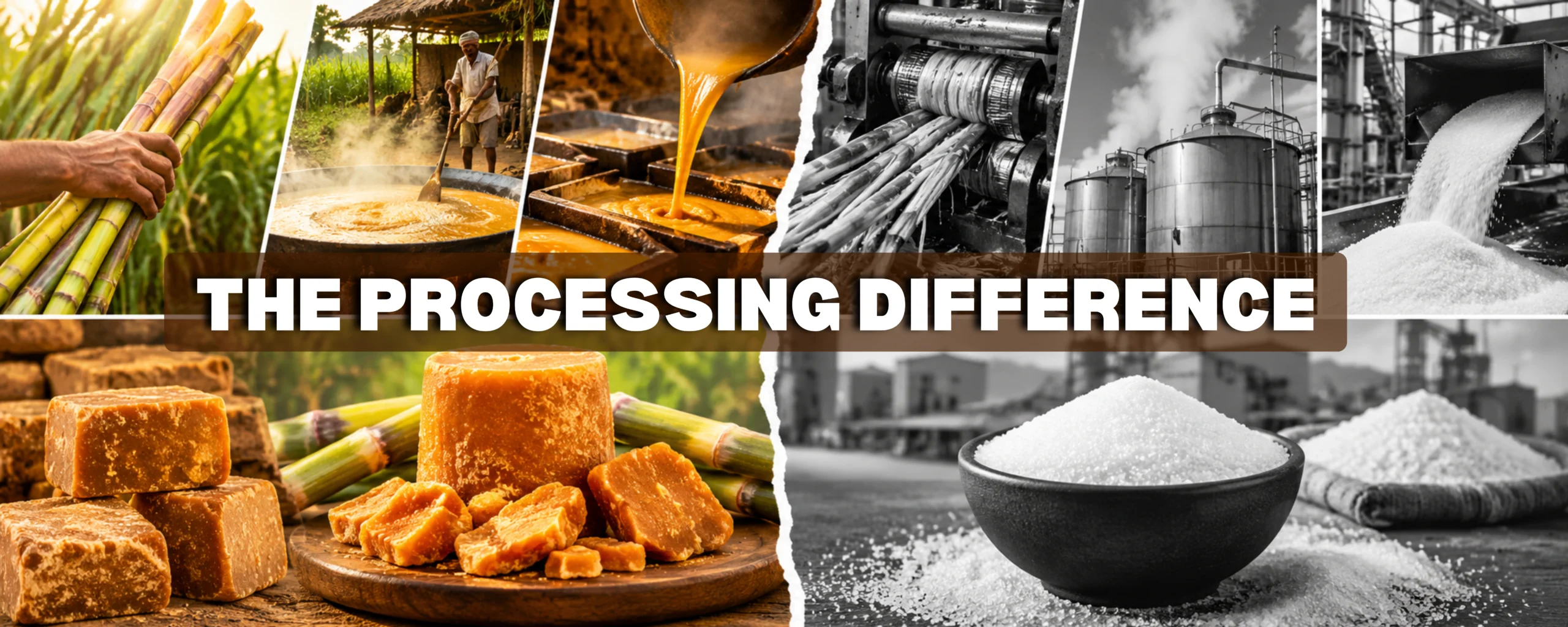
Why This Comparison Matters
Every year, millions of Indian families switch from refined sugar to jaggery believing they are making a healthier choice. Some of that belief is well-founded. Some of it is nutritional mythology. This guide separates fact from fiction with honesty — because making genuinely healthy food choices requires accurate information, not just marketing claims.
The Processing Difference
Refined sugar (white sugar) undergoes: extraction of cane juice → liming → heating → clarification → evaporation → crystallisation → centrifugation → bleaching → drying. The final product is 99.9% pure sucrose — nothing else. No minerals, no fibre, no plant compounds of any kind.
Jaggery undergoes: extraction of cane juice → clarification (traditional: okra extract/milk; commercial: sulphur dioxide) → boiling and concentration → pouring into moulds → solidification. The final product retains the natural molasses fraction — which contains minerals, trace nutrients, and plant compounds. GreenDumbells Sulphur-Free Jaggery uses traditional okra-extract clarification — no SO₂.
Glycemic Index: The Surprising Truth
The glycemic index (GI) of refined white sugar is approximately 65-70 on a scale where glucose = 100. The GI of jaggery is approximately 84-86 in most studies. This means jaggery actually has a HIGHER glycemic index than refined sugar, causing a faster blood glucose rise per gram of carbohydrate. This is a fact that most jaggery marketing conveniently ignores.
However — and this matters enormously — glycemic index is not the whole story. The minerals in jaggery, the presence of trace compounds that support insulin sensitivity, and the fact that jaggery is less processed all contribute to a nutritional profile that is genuinely superior to refined sugar despite the higher GI.
Mineral Content: Where Jaggery Genuinely Wins
This is where sulphur-free jaggery — like GreenDumbells Jaggery Powder — clearly outperforms refined sugar.
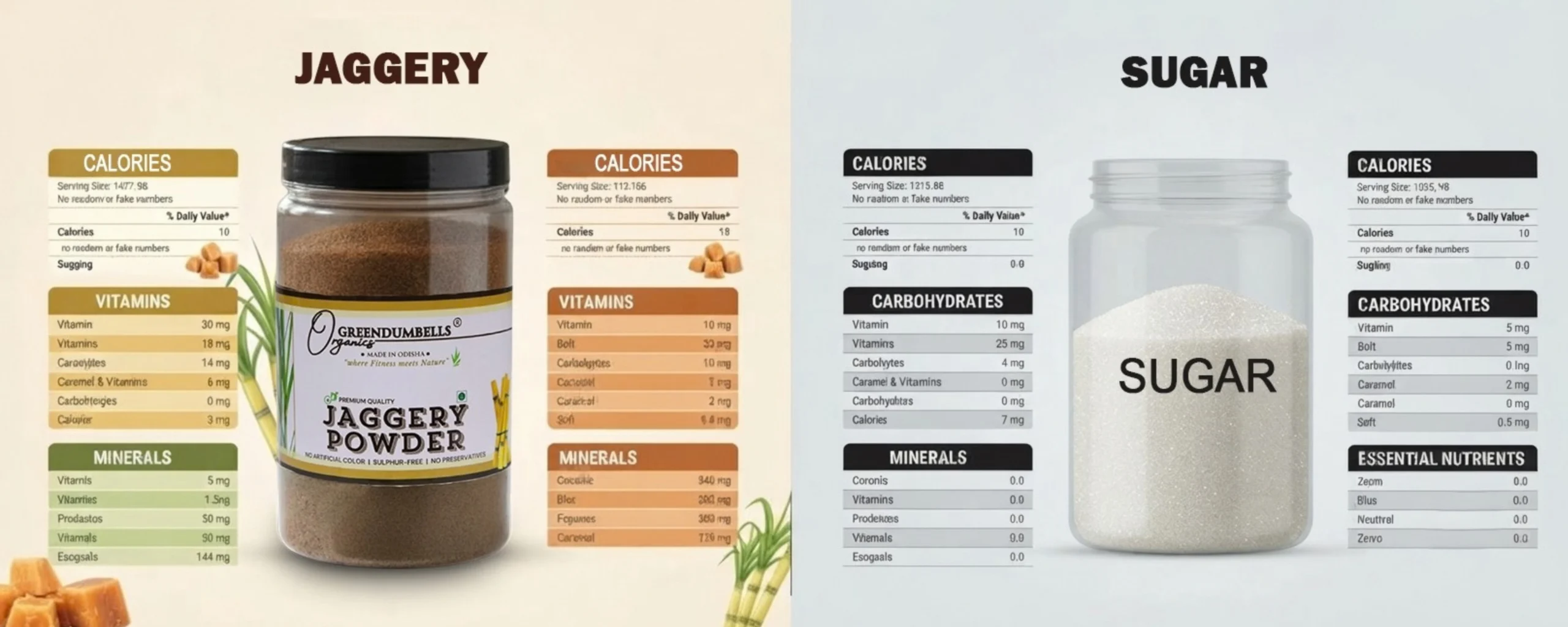
Per 100g:
Iron: Jaggery 2.64mg vs Refined Sugar 0mg.
Calcium: Jaggery 80mg vs Refined Sugar 0mg.
Potassium: Jaggery 1,056mg vs Refined Sugar 2mg.
Magnesium: Jaggery 117mg vs Refined Sugar 0mg.
Refined sugar provides nothing but sucrose calories. Sulphur-free jaggery provides meaningful amounts of iron (helping address India’s widespread iron-deficiency anaemia), potassium, magnesium, and calcium. The caveat: you need to eat enough jaggery to benefit from these minerals — the amounts per typical 10-15g serving (2 teaspoons in chai) are modest.
Calorie Comparison
Refined sugar: 387 kcal per 100g.
Jaggery: 383 kcal per 100g.
The difference is negligible — approximately 1%. Neither is a low-calorie option. Replacing refined sugar with jaggery without reducing quantity will not help you lose weight.
When Jaggery Wins: 5 Situations
- You want to reduce ultra-processed food intake — jaggery is significantly less processed than refined sugar.
- You want trace minerals with your sweetener — iron, potassium, calcium from jaggery are real benefits at scale.
- You are cooking traditional Indian recipes where jaggery’s molasses flavour is authentic — halwa, chikki, rasam, payasam.
- You have sulphite sensitivity and use sulphur-free jaggery — avoiding SO₂ that commercial jaggery contains.
- You want to align with traditional Indian nutrition philosophy — jaggery has 3,000 years of use in Ayurvedic practice.
When Refined Sugar Wins: Being Honest
For precise baking where jaggery’s molasses flavour would dominate, refined sugar is technically better. For making white-coloured sweets, refined sugar is necessary. For the lowest glycemic index among common sweeteners — counterintuitively, refined sugar wins that specific metric. In these specific contexts, refined sugar’s processing is what makes it the right tool.
For Diabetics: The Complete Honest Answer
Neither jaggery nor refined sugar is appropriate in significant quantities for diabetics. The mineral advantages of jaggery do not override its glycemic impact on blood glucose management. Diabetics who use small amounts of jaggery (5-10g per day maximum) may benefit from its mineral content over refined sugar, but this should be done under medical supervision with glucose monitoring.
Our Recommendation
Replace refined sugar with GreenDumbells Sulphur-Free Jaggery Powder in your daily chai, traditional recipes, and everyday cooking. Not because it will dramatically transform your health overnight, but because: it is significantly less processed, it provides real minerals that refined sugar does not, it contains no sulphur dioxide (if you use GreenDumbells sulphur-free), and it connects you to India’s traditional food culture. Use the same quantity as sugar — or slightly less, as jaggery is marginally sweeter.
FAQs
Q: Does replacing sugar with jaggery help with weight loss?
Ans: No — calorie content is nearly identical. Quantity reduction is what drives weight loss, not switching sweetener types.
Q: Is GreenDumbells jaggery available in different sizes?
Ans: Currently available in 500g powder and cubes at greendumbells.com.
Q: Is sulphur-free jaggery more expensive?
Ans: Yes — slightly. Traditional processing without chemical shortcuts costs more. The health and taste benefit is worth it.