
Blogs
The Complete Guide
to Cold-Pressed Oils
in India 2026
Table of Contents
Toggle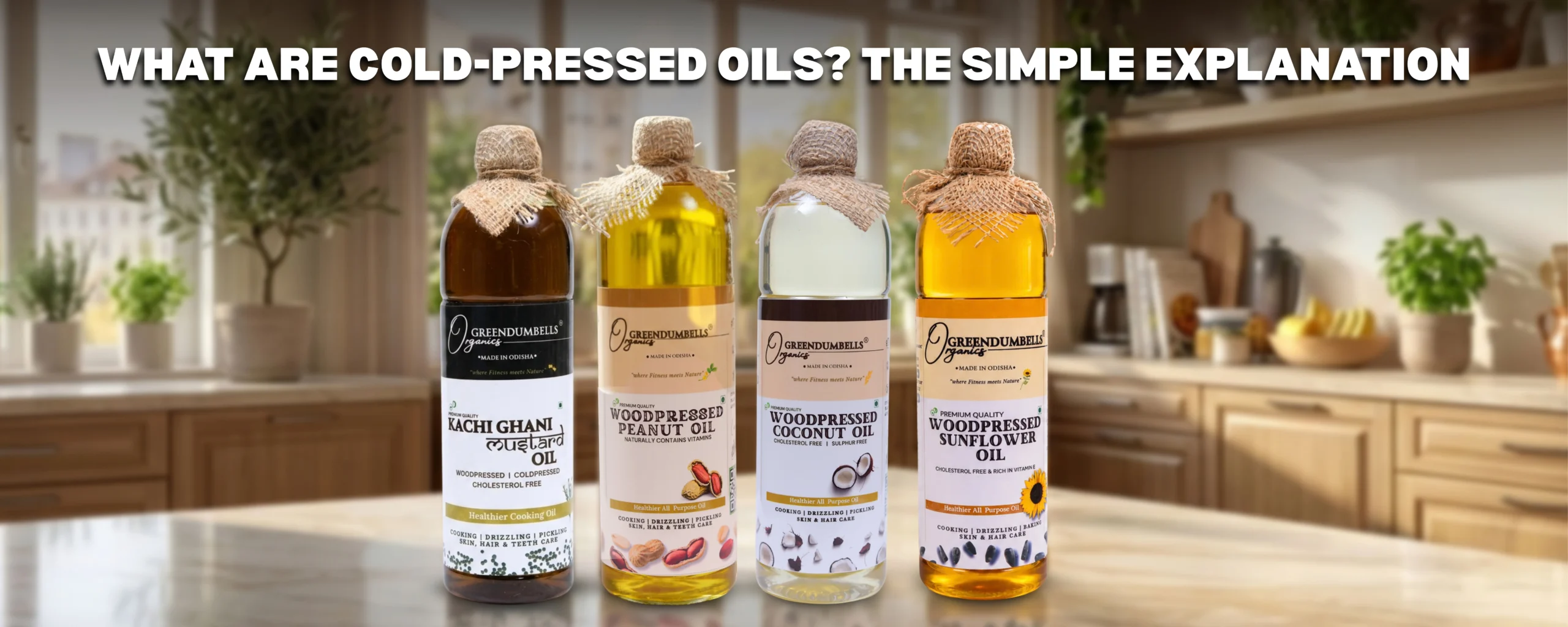
What Are Cold-Pressed Oils? The Simple Explanation
Cold-pressed oil is extracted from seeds or nuts by crushing them under mechanical pressure — without applying heat or chemical solvents. The temperature during extraction stays below 49°C (120°F). This matters because heat destroys the natural vitamins, antioxidants, and flavour compounds present in the seed.
Think of it this way: if you crush a peanut with your hand, you get peanut oil that smells of peanut, tastes of peanut, and contains all of peanut’s nutrition. That is cold-pressed oil. If you dissolve that peanut in petroleum solvent at high temperature, strip out the colour and smell, then add it back — that is refined oil.
How Traditional Wood Press (Kachi Ghani) Works
Kachi ghani is India’s oldest oil extraction method. Oilseeds — mustard, peanuts, sesame — are fed into a large wooden pestle rotated by a motor or bullock. The pestle crushes the seeds and squeezes out the oil naturally at room temperature. No heat is applied. No chemicals are used.
At GreenDumbells Organics in Bhubaneswar, we use this exact method for our wood pressed mustard oil and cold pressed peanut oil. Seeds sourced directly from Rajasthan and Odisha farmers are pressed on-site at our Bhubaneswar facility.
Cold Pressed vs Hexane Extraction: The Key Difference
Commercial edible oil production uses hexane — a petroleum-derived solvent — to extract maximum oil from seeds. Seeds are flooded with hexane which dissolves the oil. The hexane is then evaporated off. The crude oil then undergoes degumming, bleaching, and deodorising at temperatures above 200°C. This destroys natural Vitamin E, polyphenols, and the fatty acid integrity of the oil.
Cold pressed oils skip this entire process. The result looks different (darker, slightly hazy), smells different (you can smell the ingredient), and performs differently in your body.
Types of Cold-Pressed Oils in India
Wood Pressed Mustard Oil — Kachi Ghani Classic
India’s most beloved cold pressed oil. Used across Bengal, Odisha, Punjab, and Rajasthan. Has a strong pungent aroma that softens with cooking. Rich in Omega-3 fatty acids and allyl isothiocyanate — the compound responsible for mustard’s heat. GreenDumbells Wood Pressed Mustard Oil 1L is our bestselling product.
Cold Pressed Peanut Oil — High Vitamin E
Lighter in colour and flavour than mustard oil. Contains 15-17mg of Vitamin E per 100g — among the highest of any cooking oil. Perfect for South Indian cooking, stir-fries, and dosas. GreenDumbells Cold Pressed Peanut Oil is extracted at our Bhubaneswar facility from Rajasthan-sourced peanuts.
Cold Pressed Coconut Oil — For Cooking, Hair and Skin
Unique among cooking oils — it is solid below 24°C and liquid above. If your coconut oil never solidifies even in winter, it has been blended with refined oil. Rich in lauric acid with antifungal and antimicrobial properties. Used for cooking in South India and as a hair and skin oil across the country.
Cold Pressed Sunflower Oil — Mild and Light
The mildest of all cold pressed oils — neutral colour and flavour. Excellent for baking, light sautéing, and salad dressings. Contains the highest Vitamin E among common cooking oils. Perfect for families who want cold pressing benefits but prefer a neutral flavour.

Health Benefits: What Science Says
Preserved Vitamins and Antioxidants
Cold pressed oils retain natural Vitamin E (tocopherol) content that gets largely destroyed during high-temperature refining. Studies in the Journal of Agricultural and Food Chemistry show cold pressed oils contain 2-4x more tocopherols than refined counterparts. Vitamin E protects cell membranes from oxidative damage and has documented cardiovascular benefits.
Zero Hexane Residue
Cold pressed oils contain zero hexane because zero hexane is used. For families with young children or anyone concerned about long-term chemical exposure, this is non-negotiable. There is simply no acceptable level of petroleum derivatives in food for health-conscious consumers.
Natural Flavour and Aroma
When you heat GreenDumbells Wood Pressed Mustard Oil, you can smell the mustard. Our Cold Pressed Peanut Oil smells of roasted peanuts. These volatile aromatic compounds — destroyed by high-temperature refining — are fully preserved in cold pressed extraction, making your cooking genuinely more flavourful.
Cold Pressed vs Refined Oil: Honest Comparison
Smoke Point: Cold pressed oils have a slightly lower smoke point than refined oils because natural compounds are present. Refined oils have artificially raised smoke points via bleaching. For everyday Indian cooking — tempering, sautéing, medium-heat frying — cold pressed oils work perfectly. Only for sustained high-temperature deep frying should you be cautious.
Price: Cold pressed oils cost 2-4x more than refined oils. The yield per kilogram of seeds is lower with mechanical pressing versus hexane extraction, and the process is slower. However, when you calculate cost per serving and factor in health benefits, the premium is absolutely justified.
Shelf Life: Cold pressed oils last 6-12 months versus 24-36 months for refined oils. Natural antioxidants eventually oxidise — while refined oils are artificially preserved. Always check the manufacture date and store in a cool, dark place.
5 Home Tests to Identify Pure Cold Pressed Oil
The Refrigerator Test: Pure cold pressed coconut oil solidifies below 24°C. If your coconut oil never solidifies even in an air-conditioned room — it has been blended with refined oil. For mustard oil: pure kachi ghani becomes slightly thick (not solid) in cold weather.
The Smell Test: Genuine cold pressed oil smells like its ingredient. Mustard oil smells pungently of mustard. Peanut oil smells of roasted peanuts. Coconut oil smells of fresh coconut. Refined oils are deodorised — they smell of nothing. If your oil has no smell at all, it has been deodorised.
The Colour Test: Cold pressed oils are naturally darker and often slightly hazy. Refined oils are crystal-clear because they have been bleached and ultra-filtered. A perfectly clear, odourless groundnut oil is a refined groundnut oil, whatever the label says.
The Sediment Test: Authentic cold pressed oils may have a small amount of natural sediment at the bottle bottom. This is fine seed particles that passed through natural filtering. This is not a defect — it is proof of natural extraction. Refined oils have zero sediment because they are ultra-filtered.
The Label Test: Check for Cold Pressed or Wood Pressed or Kachi Ghani explicitly stated. No mention of refined, filtered, bleached, or deodorised. A valid FSSAI license number. Manufacture date within the last 6-12 months. Country and state of origin for the seeds.
How to Store Cold Pressed Oils
Store away from direct sunlight — light accelerates oxidation and reduces shelf life. A dark glass bottle or opaque container in a cool kitchen cupboard is ideal. Never store near your gas stove — the heat degrades quality over time. Always close the cap tightly after each use to prevent air oxidation. Do not refrigerate mustard or peanut oil — they can become thick and difficult to use.
Where to Buy Genuine Cold Pressed Oils in India
GreenDumbells Organics at greendumbells.com offers pan-India delivery of all cold pressed oils: Wood Pressed Mustard Oil 1L, Cold Pressed Peanut Oil 1L, Cold Pressed Coconut Oil 1L, and Cold Pressed Sunflower Oil 1L. All products are FSSAI Licensed, hexane-free, and sourced from trusted farms in Odisha, Rajasthan, and Kerala. Available at 400+ retail counters across Odisha.
Look for brands that show the extraction method explicitly, farm sourcing information, FSSAI license numbers, and ideally lab test reports. Avoid brands that use vague terms like “natural” or “pure” without specifying the extraction process — these terms have no regulatory definition in India.
Frequently Asked Questions
Ques: Is cold pressed oil better than refined oil for everyday Indian cooking?
Ans: For daily cooking — tempering, sautéing, medium-heat frying — cold pressed oil is significantly better. It retains natural flavour, Vitamin E, and contains no chemical residues. For sustained deep frying at very high temperatures, use with moderate care.
Ques: Why does my cold pressed oil have a strong smell?
Ans: That strong smell is a sign of authenticity. Refined oils are deodorised — all aroma removed. Cold pressed oils retain their natural characteristic scent, which also adds flavour to cooking.
Ques: How long does cold pressed oil last after opening?
Ans: 6-12 months from manufacture date. After opening, consume within 3-4 months for best flavour. Store tightly capped in a cool, dark place.
Ques: Is GreenDumbells cold pressed oil FSSAI certified?
Ans: Yes. GreenDumbells Organics is FSSAI Licensed. All products comply with Indian food safety standards. Available at greendumbells.com.